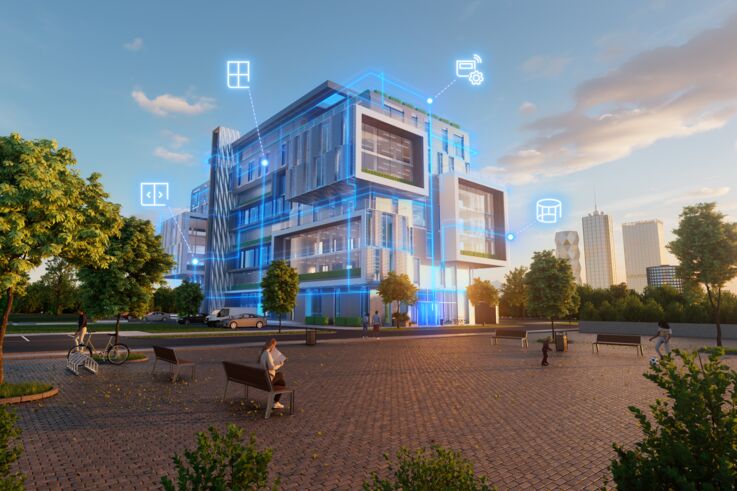
Smart building automation for critical infrastructure buildings
Critical infrastructures are increasingly the focus of regulatory requirements, increasing threat scenarios and rising expectations in terms of availability and security. In addition to IT systems and networks, buildings are also becoming increasingly important, as the building envelope forms a security-relevant interface.
What advantages does building automation offer for critical infrastructure sectors?
Efficient and secure building automation and control system for GEZE products.
Building automation offers concrete added value to building operators in the health care sector, in public buildings, in transport and in other areas relevant to critical infrastructure in the context of the IT Security Act 2.0 and the critical infrastructure umbrella law:
The building envelope is a potential point of attack on infrastructure that requires special protection. This applies in particular to properties that fall within the scope of critical infrastructure according to NIS2. The goal is to prevent unauthorised access to all technologies networked within the system. OPC UA currently offers us the most secure method of adequately protecting the necessary communications to all monitoring systems. Encryption and certificate-based communication make attacks on transmissions extremely difficult.
Building automation increases resilience to cyber attacks and technical outages and facilitates compliance with regulatory obligations. Centralised monitoring, logging, encryption, role-based access and redundancies enable risks to be systematically assessed, faults to be detected more quickly and measures to be documented in a traceable manner – including support with risk analyses and reporting and documentation obligations to the BSI.
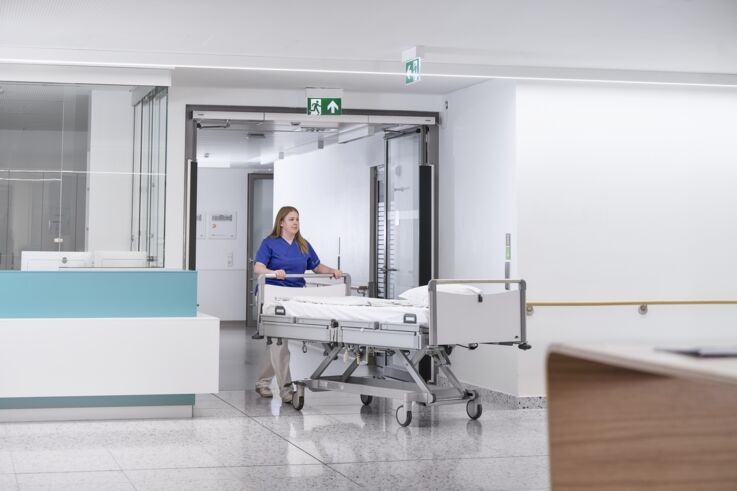


How do networked doors and windows contribute to the resilience of critical infrastructure?
Door, window and safety systems are centrally networked with myGEZE Control.
Modern buildings have long been part of digital ecosystems. Anyone who takes a holistic view of critical infrastructure requirements must therefore also consider doors and windows as networked, controllable and monitorable components. Doors and windows form the physical boundary between interior and exterior, and separate sensitive areas of the building from public spaces. They perform key functions in buildings relevant to critical infrastructure, such as power supply, health care and public buildings:
- Protection against unauthorized access
- Ensuring defined operating statuses and system availability
- Support for emergency and evacuation scenarios
- Traceability and transparency for operators and control centres
However, without networking, these elements remain isolated individual solutions – without real-time status, without central control and without integration into higher-level security or building management systems.
Networking and building automation as the key to critical infrastructure compliance
myGEZE Control basic device for networking doors and windows and integration into building management systems.
The myGEZE Control building automation solution, developed in collaboration with Beckhoff Automation, networks doors and windows and enables their integration into manufacturer-neutral building management systems. Intelligent networking means that the building envelope is not only monitored, but can also be actively controlled.
Specifically, the building automation and control system myGEZE Control offers numerous advantages relevant to critical infrastructure:
- Central overview of door and window statuses (open, closed, locked, set operating mode, as well as alarms and faults)
- Recording of every status change for complete traceability in the event of unwanted actions
- Automated actions for building protection; e.g. time-based functions for changing the operating mode (night mode, night-time closer), automated responses to defined events such as alarms, evacuations
- Early detection of malfunctions even before system failure thanks to the wide range of data that is transmitted
- Reduction of manual interventions and sources of error
- Increasing resilience through transparent and reproducible processes
thanks to the building automation solution myGEZE Control, the building envelope becomes an active component of the security architecture rather than a blind spot.
Secure communication with OPC UA
The communication protocol is a key element for networking in critical infrastructure. myGEZE Control uses OPC UA (Open Platform Communications Unified Architecture) – currently the most secure technology for industrial data exchange, which was developed specifically for safety-critical applications.
OPC UA offers decisive advantages:
- Encrypted and authenticated communication
- Manufacturer-independent interoperability
- Scalability for complex building structures
- Recognised in critical infrastructure environments
This communication protocol is appropriate for critical infrastructure and allows doors and windows to be securely integrated into existing control, security and building management systems without the need for customised or manufacturer-specific individual solutions. This is crucial in order to achieve uniform security standards and reduce interface risks. This will soon be supplemented by communication with BACnet Secure Connect (BACnetSC), which is also designed with security in mind. The relevant specifications are already available, and myGEZE Control will provide this function in an upcoming version.
More than just access: control, monitoring and traceability
myGEZE Control and myGEZE Visu enable networking, compliance and auditability in façade control with early detection.
Critical infrastructure requirements cover more than just protection against unauthorized access. Traceability, documentation and controlled operating status are also crucial.
By networking with myGEZE Control in combination with the myGEZE Visu visualisation system, operators can
- Ensure that defined security states are maintained,
- Identify deviations at an early stage,
- Record and evaluate events on the system side,
- Standardise processes and make them auditable.
Building automation thus enables a compliant and smart façade that meets both physical and digital security requirements.
Critical infrastructure overview
What is critical infrastructure?
Critical infrastructures are facilities and services in areas such as energy, health, transport, information technology, water, food, finance and insurance, and waste disposal, whose failure or impairment would lead to significant supply bottlenecks or threats to public security (in accordance with the BSIG and BSI-Kritisverordnung, as well as the NIS2 Implementation Act and Critical infrastructure umbrella law).
How is critical infrastructure security implemented in practice?
In practice, implementation usually follows a clear process: First, a check is carried out to determine whether an operator is classified as a critical infrastructure operator – including thresholds and the area of application of the relevant laws. This is followed by an analysis of protection requirements and risks, and identification of an information security and resilience concept. On these bases, state-of-the-art technical and organisational measures are planned and implemented. At the same time, the necessary documentation and evidence for inspections and audits is compiled, and reporting, alerting and response processes for security incidents are established. Finally, regular audits, tests and exercises ensure effectiveness and enable the continuous development of measures in response to new threats and regulatory requirements.
What makes a critical infrastructure building particularly relevant to security?
In critical infrastructure environments, buildings are relevant to security because technical systems and the building envelope (e.g. access, smoke and heat extraction, ventilation, power supply) directly influence the availability and security of operations and must therefore be protected against external attacks.
What role does building automation play in critical infrastructure requirements?
Building automation creates transparency and responsiveness: conditions are monitored centrally, faults are detected early and processes are standardised – including security in communication and logging.
What is important when retrofitting existing buildings?
For efficient retrofitting of building automation, step-by-step planning with clear interfaces, minimal downtime and a coordinated security concept are crucial to ensure operational continuity and compliance even during the conversion.

Efficient planning and implementation – across all project phases
For building automation to be effective in critical infrastructure environments, careful planning is required: from defining objectives and system architecture to interfaces and security concepts, commissioning, documentation and ongoing operation. We provide you with comprehensive support in every phase of the project – from new construction to modernisation of existing buildings. Even for retrofitting, we examine the existing infrastructure, develop a step-by-step migration concept and support implementation in such a way that availability, IT security and operational continuity always remain the focus.